When Should You Disclose a Disability in Online Dating?

HIGHLIGHTS
- Honesty, confidence, timing – and why I recommend disclosing a visible disability before the first in-person date.
- You do not owe a stranger your complete medical history, and disclosure does not have to be the first line of your profile.
- For a visible physical disability, my preference is to disclose after some initial rapport but before the first in-person meeting.
- Research shows disabled online daters use a range of disclosure strategies , and some use proactive disclosure to filter for partners who are genuinely comfortable and compatible.
- The goal is not to “warn” someone. It is to communicate honestly, confidently, and without allowing disability to become your entire identity.
Dating apps give us something previous generations never had at this scale: the ability to meet someone, talk for days or weeks, and form an impression before we ever share the same physical space. For a person living with a disability, that can be empowering – but it can also create a difficult question: When should I tell this person about my disability?
I live with cerebral palsy and use a power wheelchair. My view is straightforward: if you have a visible physical disability that will obviously be part of the first in-person meeting, I believe in disclosing it before that meeting. But I do not believe you need to introduce yourself by leading with disability, nor do I believe a dating profile must read like a medical chart.
There is an important middle ground: let the person first experience your personality, interests, humour, values, and communication style. Then, once some basic rapport exists and a meeting is becoming realistic, disclose the disability calmly and matter-of-factly. That approach protects honesty without allowing one characteristic to overshadow the whole person.
Why Disability Disclosure Feels So Complicated Online
Disability disclosure is not just about facts. It is also about identity, stigma, privacy, attraction, safety, and the understandable desire to be evaluated as a complete human being rather than reduced to a diagnosis.
Research has documented exactly this tension. Natasha Saltes’ study of 108 disabled people who used online dating found that disability continued to shape self-presentation even when the body itself was not physically present in the digital interaction. In other words, online dating may temporarily remove visible cues, but disability can still influence how people decide what to reveal, when to reveal it, and how to frame it.
A later study of online dating disclosure practices found that expectations varied depending on the disability, with visible disabilities carrying a stronger expectation of upfront disclosure than non-apparent disabilities. Some disabled respondents also described proactive disclosure as a way to filter potential partners rather than investing time in someone who would ultimately be uncomfortable.
That distinction matters. Disclosure should not be framed as an apology or a warning. It is a compatibility conversation.
My Position: Build a Little Rapport, Then Disclose Before Meeting
I do not think every person with a disability needs to put that information in the first line of a dating profile. Doing so may cause some people to swipe away based on assumptions before they have learned anything about your personality. At the same time, if your disability is immediately visible in person, I do not recommend waiting until you arrive at the restaurant, coffee shop, or event for the other person to discover it for the first time.
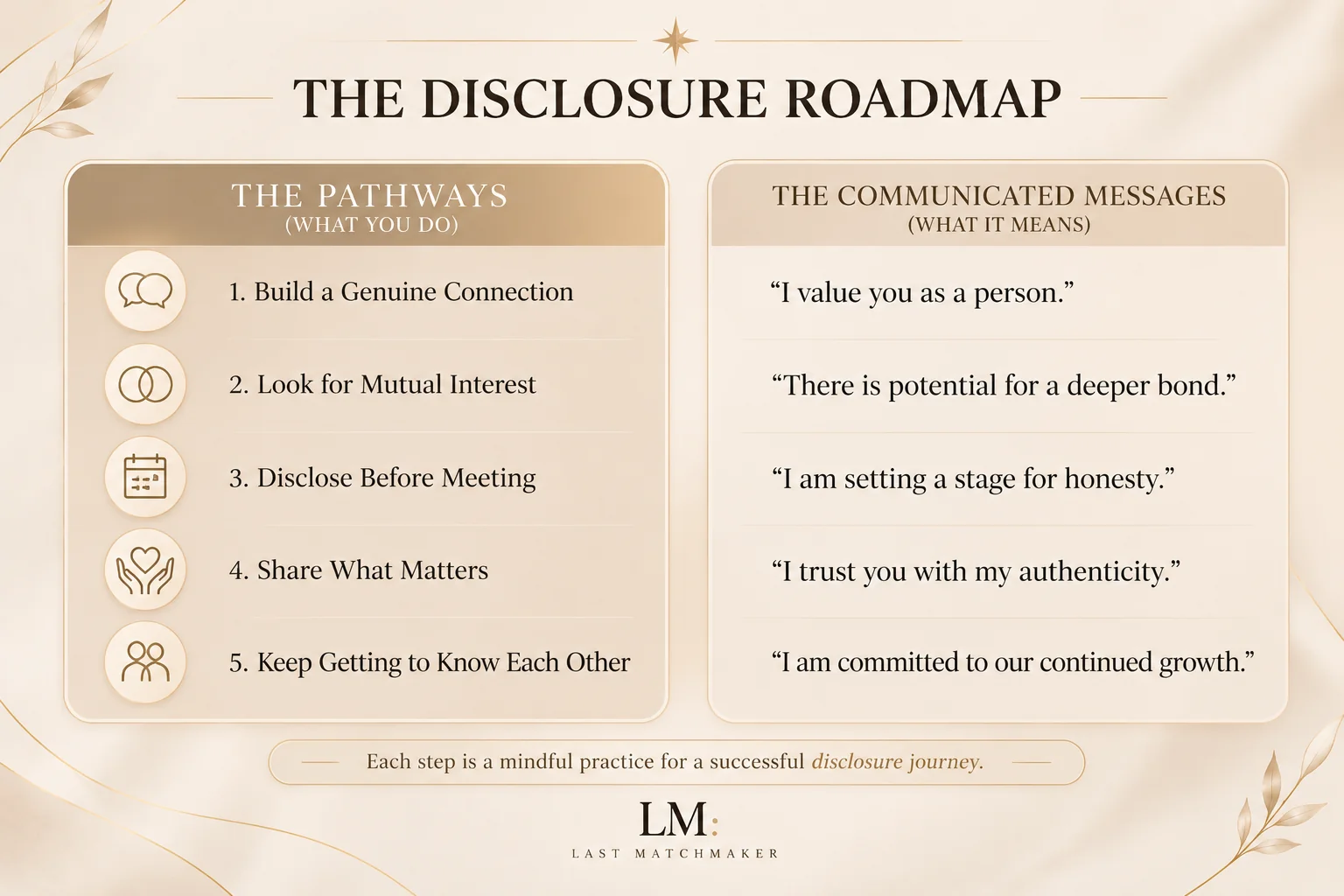
My preferred sequence is simple:
- Let a genuine conversation begin. Talk about the same things any two people would discuss – interests, values, work, family, goals, humour, hobbies, and what you are both looking for.
- Look for reciprocal interest. If the conversation is one-sided or never moves toward a real meeting, there may be no reason to share more personal information yet.
- Disclose before the first date is finalized. Once you are both seriously discussing a meeting, tell the person clearly enough that they understand what they will see and whether any practical accessibility planning is needed.
- Keep the disclosure proportional. Give enough information to be honest and useful. You do not need to explain your entire medical history, every surgery, or every difficult experience on day one.
- Return to the relationship conversation. After answering reasonable questions, move forward. Disability is part of your life; it does not need to consume the date before the date has even happened.
Visible and Non-Apparent Disabilities Are Not Exactly the Same
A visible mobility disability and a non-apparent condition create different disclosure decisions. Research on disability and online dating repeatedly shows that there is no single universal timetable that works for every person or every condition.
With a visible physical disability, the first meeting will reveal the information immediately. That is why I favour disclosure before meeting: it prevents surprise, allows both people to enter the date with accurate expectations, and gives you a chance to present the information in your own words rather than forcing the other person to interpret it in real time.
With a non-apparent disability – including some mental health, neurodevelopmental, chronic health, or sensory conditions – the timing may reasonably depend more on relevance, trust, safety, and how quickly the condition affects the developing relationship. Recent research on autistic adults and studies involving Deaf and hard-of-hearing daters also describe disclosure as highly personal, shaped by anticipated reactions, communication needs, and safety concerns.
So my principle is not “tell everyone everything immediately.” My principle is: do not create a false picture of yourself, and disclose important information at the point when it becomes relevant to trust, safety, accessibility, or the reality of meeting you in person.
How to Disclose Without Turning It Into a “Confession”
The emotional tone matters almost as much as the information itself. If you present your disability as if you are announcing terrible news, the other person may unconsciously follow your lead. If you present it as one ordinary part of a full life, you give them a more accurate frame.
For me, a disclosure can be brief, confident, and even playful. I might say something along the lines of:
“By the way, I have cerebral palsy and use a power wheelchair to get around. It’s simply part of my life. The good news is, the chair is fully paid for.”
The humour is optional. Confidence is not. A good disclosure generally does four things:
- Names the disability or functional reality in plain language.
- Explains only what the other person reasonably needs to know at this stage.
- Signals that you are comfortable answering respectful questions.
- Makes clear – through tone and content – that you still have a full identity, lifestyle, and relationship goals beyond disability.
The point is not to perform confidence or pretend disability never creates challenges. The point is to communicate from self-respect rather than shame.
What Rejection After Disclosure Really Tells You
One reason people delay disclosure is fear of rejection. That fear is understandable. But delaying important information cannot guarantee acceptance; it only postpones the moment when compatibility becomes clearer.
If somebody loses interest after learning about your disability, that can hurt – but it is also useful information. The purpose of dating is not to persuade every person to choose you. It is to discover mutual fit. A person who is unwilling, uncomfortable, or simply not attracted to the reality of your life is unlikely to become a healthy long-term match through additional persuasion.
This is where disclosure can become a filter. It lets you invest more energy in people who respond with curiosity, respect, normalcy, and genuine interest – and less energy trying to win over people who have already decided they are not compatible.
Authentic Photos Matter Too
Disclosure is only one part of honest online self-presentation. Your photos should also reflect what you currently look like. Using images that are dramatically outdated, heavily misleading, or intentionally hide major aspects of your present appearance creates the same basic problem: the person is building expectations around information that is no longer accurate.
That does not mean you should post unflattering photos. Present yourself well. Wear something you like. Choose good lighting. Smile. Use photos that show your personality. Authenticity and attractiveness are not opposites.
For a wheelchair user, I personally favour including or sending at least one clear photo that shows the chair once disclosure has happened. It eliminates ambiguity and communicates something important: I am not hiding my life, and I am not ashamed of it.
Accessibility, Safety, and Planning the First Date
Once both people want to meet, disclosure can also make the first date easier to plan. Accessibility is practical, not romantic – but poor planning can ruin an otherwise promising evening.
If mobility access matters, confirm the entrance, washroom access, seating, parking or transit arrangements, and any other relevant logistics before the date. If communication access matters, choose an environment where both people can communicate comfortably. The objective is to reduce preventable friction so the date can actually be about chemistry and connection.
Online dating also carries ordinary safety risks that apply to everyone: meet in a public place, let someone you trust know where you are going, protect financial and identifying information, and be cautious with anyone who pushes secrecy, requests money, avoids video calls, or creates urgent crises very early in the connection.
A Practical Disclosure Guide
Conclusion: Disclosure Is About Compatibility, Not Apology
Disability disclosure in online dating is personal, and no single rule can capture every disability, every platform, or every person. But when a disability is visible and will obviously be part of the first in-person interaction, I believe honesty before meeting is usually the strongest approach.
You do not need to lead with a disability. You do not need to make it your dating brand. And you certainly do not need to apologize for it. Let the person get to know you. Then, before meeting, tell them clearly and confidently enough that there are no misleading expectations.
The right disclosure does not say, “Will you accept me despite this?”
It says, “This is one part of my life. Now let’s find out whether we are actually compatible.”
FAQs About Disability Disclosure in Online Dating
Should I Put My Disability Directly in My Dating Profile?
You can, but I do not think everyone has to. If you prefer to let conversation develop first, that is reasonable. For a visible disability, I still recommend disclosing before an in-person meeting.
Am I Being Dishonest if I Do Not Disclose Immediately?
Not necessarily. Privacy and deception are different things. You are allowed to decide when personal information becomes relevant. The key is not to create a materially false expectation once the relationship is moving toward an in-person date.
How Much Detail Should I Give?
Usually enough to explain the reality of meeting you and any relevant accessibility needs. More personal medical details can be shared gradually as trust develops.
What if They Reject Me After I Disclose?
Treat it as information about compatibility, not a verdict on your value. Dating requires mutual interest. A respectful “no” is better than investing months in someone who is fundamentally uncomfortable with your life.
What if They Ask Intrusive Questions?
You can answer what you are comfortable answering and set a boundary around the rest. Curiosity can be healthy; entitlement to your entire medical history is not.
Research Notes & Sources
This article combines lived experience and relationship-coaching perspective with published research on disability, online dating, self-presentation, and disclosure. The research does not establish one mandatory disclosure rule; it documents varied strategies and the social pressures disabled daters navigate.
- 1 Saltes, N. (2013). “Disability, identity and disclosure in the online dating environment.” Disability & Society, 28(1), 96–109.
- 2 Porter, J. R., Sobel, K., Fox, S. E., Bennett, C. L., Kientz, J. A., & Shinohara, K. (2017). “Filtered Out: Disability Disclosure Practices in Online Dating Communities.” Proceedings of the ACM on Human-Computer Interaction, 1(CSCW).
- 3 Fitzpatrick, K. et al. (2022). “Dating in the Digital Age: A Content Analysis of Dating Websites Designed for Disabled People.” Sexuality and Disability.
- 4 Zhu, X., Cao, J., Niu, Z., Zhang, J., & Tong, X. (2023). “Investigating Deaf and Hard-of-Hearing (DHH) Individuals’ Online Dating Practices, Self-Presentation, and Disability Disclosure.” ASSETS ’23.
- 5 Gibbs, V. et al. (2026). “Navigating Online Dating: Autistic Adults’ Experiences of Connections, Disclosure, and Safety.” Autism in Adulthood.

