Neurodivergent Dating: Practical Tips for Autistic Adults
Highlights
-
01
1 Spectrum, Many Experiences:
Autism affects individuals differently, and autistic adults can experience attraction, intimacy, and lasting romantic commitment.
-
02
Communication Matters:
Direct conversations about expectations, feelings, and boundaries can reduce misunderstandings and strengthen relationships.
-
03
Sensory-Friendly Dating:
Comfortable environments, thoughtful planning, and respect for sensory preferences can make dating more enjoyable.
-
04
2 Partners, Mutual Understanding:
Healthy neurodivergent relationships require reciprocal accommodation, patience, and respect for individual differences.
-
05
Online Dating Opportunities:
Research suggests online dating can give autistic adults greater control over initial communication, while presenting challenges involving safety and social expectations.
-
06
Compatibility Over Conformity:
Meaningful relationships grow through shared values, trust, and authentic connection — not conventional dating rules.
Dating can be challenging when social expectations, communication styles, and sensory experiences don't always align. For autistic adults, finding meaningful romantic connections may involve navigating situations that traditional dating advice rarely addresses.
In this article, Chris Del Duca, a psychology graduate and disability support professional, explores practical approaches to neurodivergent dating, from communicating openly and choosing comfortable date settings to building relationships grounded in mutual understanding, respect, and genuine compatibility.
Research source: Read the 2026 study. These percentages describe the study participants, not all autistic adults.
However, the research also identified challenges involving stigma, disclosure, and online safety. At Last Matchmaker, we believe meaningful connections begin with understanding individual needs, respecting personal boundaries, and recognizing that there is no single approach to finding love that works for everyone.
Understanding Neurodivergent Dating
Everyone deserves the opportunity to experience love, companionship, and meaningful romantic connection. Yet dating can feel confusing when familiar social rules do not match the way you communicate or experience the world. Neurodivergent dating recognizes that there is no single correct way to develop a relationship.
Neurodivergence is an umbrella term describing natural differences in how people think, learn, process information, or interact; it includes autism, among other conditions. Autism spectrum disorder (ASD) is a neurodevelopmental condition associated with differences in social communication, patterns of interests or behaviour, and sometimes sensory processing. Autism is a spectrum because experiences, abilities, support needs, and preferences vary considerably from person to person.
In short: Being autistic does not prevent someone from experiencing attraction, affection, intimacy, or lasting commitment. Focus on discovering what works for both partners rather than following conventional dating rules.
Why Dating Can Feel Different for Autistic Adults
Dating often involves unspoken expectations: knowing whether someone is flirting, deciding when to text, interpreting eye contact, or recognizing a subtle invitation to meet again. Some autistic adults prefer direct communication and may find hints or ambiguous signals difficult to interpret. Others are highly perceptive but still feel exhausted by the social effort involved.
Sensory environments also matter. A noisy restaurant, harsh lighting, crowded bar, or unexpected physical contact may distract from connection or feel overwhelming. Changes in plans can create additional uncertainty, while expressions of affection may look different from what a partner expects.
In a qualitative study of autistic adolescents and adults, Beato and colleagues (2024) explored experiences of romance, intimacy, and sexuality, including the need for accessible, practical relationship guidance. These findings point to a useful principle: understand the individual, not a stereotype. Some autistic people enjoy spontaneous dates and frequent touch; others value predictability, quiet spaces, or more personal room.
Practical Dating Tips for Autistic Adults
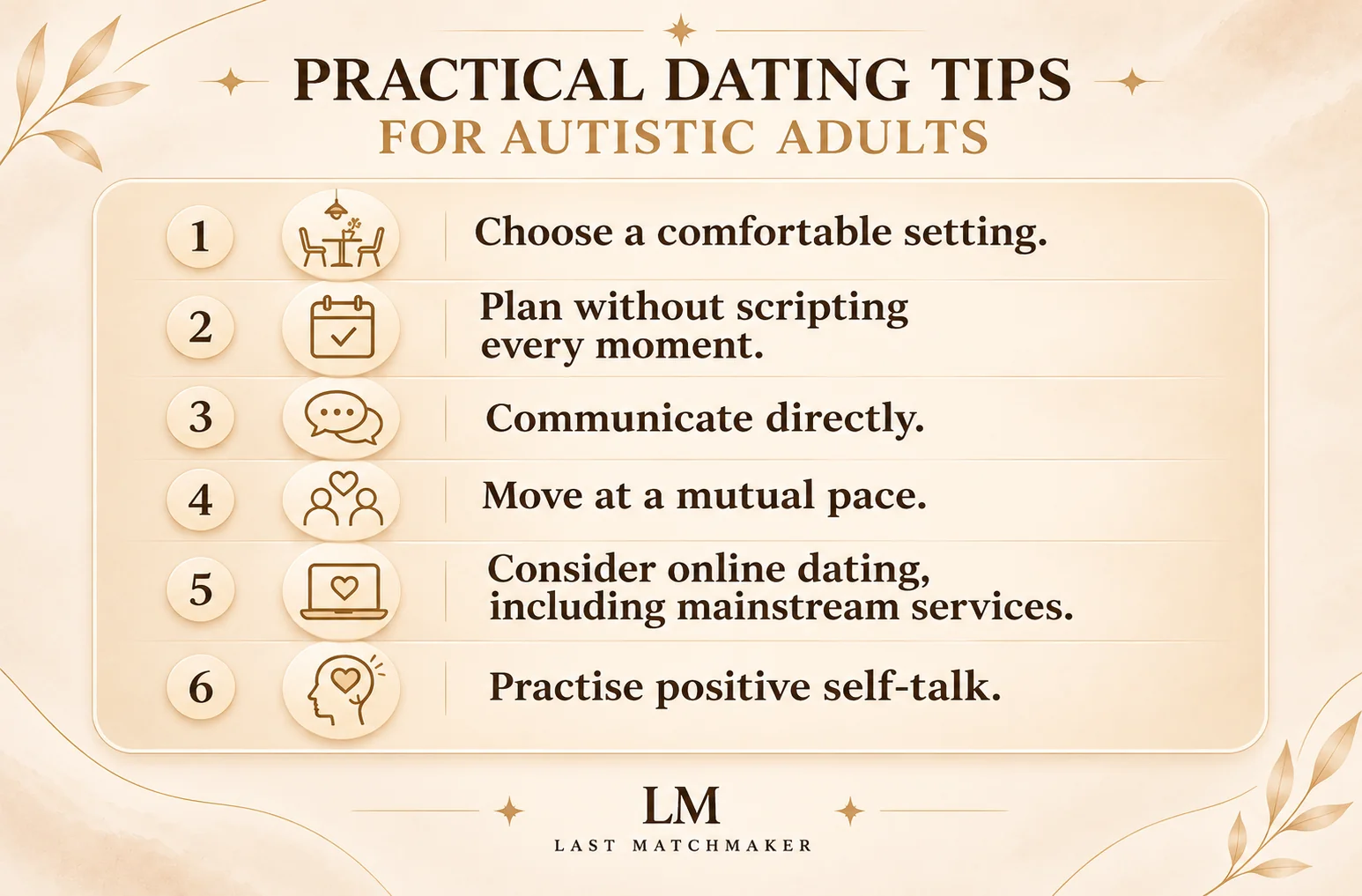
Dating doesn't have to follow a fixed set of rules. These six practical tips can help autistic adults navigate dating with greater confidence, comfort, and authenticity.
Putting These Tips Into Practice
-
Choose a Comfortable Setting.
Suggest a quiet café, an accessible museum, a walk in a familiar park, or another setting that supports conversation. It is perfectly reasonable to ask about lighting, noise, seating, or how busy a venue becomes.
-
Plan Without Scripting Every Moment.
Check the meeting place, transit route, duration, and a backup option. Prepare a few open-ended questions about hobbies, values, or favourite experiences. Planning can reduce uncertainty; curiosity keeps the interaction genuine.
-
Communicate Directly.
You might say, “I sometimes miss hints, so I appreciate straightforward communication,” or “I enjoy spending time with you and would like another date.” Clear statements are not less romantic than guessing games.
-
Move at a Mutual Pace.
No one owes a kiss, physical contact, or exclusivity after a particular number of dates. Ask before initiating touch, respect a refusal, and discuss what helps each person feel comfortable.
-
Consider Online Dating, Including Mainstream Services.
A 2024 scoping review by Neumann and colleagues examined eight studies and found that online platforms can offer autistic users more control over initial communication, alongside challenges involving social expectations and safety.
Use a truthful profile, protect personal information, watch for pressure to send money, and meet new people in public when it feels safe.
-
Practise Positive Self-Talk.
In my own writing about dating while living with a disability, I emphasize focusing on the process rather than measuring your worth by whether a date leads to a relationship.
A more useful question than “Will they like me?” is “Do we enjoy each other’s company, and are we compatible?” Rejection can hurt, but it does not determine your value.
Above all, you do not need to force eye contact, imitate flirting styles, or conceal your natural communication preferences to be worthy of connection. If you prefer a written conversation before meeting, explain that preference honestly. You can also arrange a brief first meeting instead of a long evening together, then decide whether to extend it. This approach gives both people permission to discover compatibility at a comfortable pace.
How to Date Someone with Autism: Advice for Non-Autistic Partners
If you are wondering how to date someone with autism, begin with the same respect and curiosity you would bring to any relationship. Ask how the person prefers to communicate, whether advance notice helps with plans, and what makes a date enjoyable.
Be specific rather than relying exclusively on hints. “Would you like to have dinner on Saturday?” is clearer than “We should hang out sometime.” If a partner requests quiet time, ask what that means for them instead of assuming it signals rejection.
Respect sensory boundaries and remember that emotional warmth does not always appear through conventional facial expressions, eye contact, or physical affection. Sala and colleagues (2024) found varied experiences of physical intimacy among autistic adults, including differences in sensory comfort and the importance of touch. The point is not that autistic people dislike affection; it is that preferences deserve discussion.
Source: Sala et al. (2024), Journal of Autism and Developmental Disorders .
Both partners have needs. Neurodivergent dating works best when accommodation and compromise are reciprocal, not when either person is expected to erase who they are. For example, one partner might enjoy busy social gatherings while the other prefers a quiet evening. A workable compromise could involve attending an event together for a shorter period and scheduling downtime afterward. Being considerate does not require identical preferences; it requires taking each other seriously.
Dating a Man or Woman with Autism: Look Beyond Labels
Some readers search for advice about dating a man with autism or dating a woman with autism, hoping for a straightforward guide. However, gender alone cannot explain someone’s personality, communication style, boundaries, or relationship goals. Social expectations and experiences of masking — consciously or unconsciously hiding autistic traits — can also influence how someone presents themselves.
People searching for advice about dating someone with high functioning autism may encounter this terminology online. However, functioning labels can oversimplify the diverse abilities, experiences, and support needs of autistic individuals. Rather than assuming someone needs little support or cannot handle intimacy, ask about the specific circumstances that matter to them.
Dating for neurodivergent adults should emphasize personal compatibility, individual communication preferences, and mutual respect. Whether dating as a neurodivergent person or dating a neurodivergent partner, approach each relationship as a chance to learn about a whole human being: their humour, values, ambitions, interests, and unique ways of showing care.
Building a Healthy Relationship Together
Once a connection grows, practical conversations become even more important. Talk about how often to communicate, preferred ways of expressing affection, personal space, social commitments, sexual boundaries, and what each partner needs during stressful periods. Consider simple agreements, such as checking before changing plans or sending a direct message when one person needs alone time.
Disagreements are inevitable. Instead of assuming bad intentions, describe the situation and its impact: “When plans changed suddenly, I felt unsettled. Could we agree on a backup plan next time?” Listen to the response, validate the other person’s perspective, and look for a solution that respects both people.
My professional dating philosophy repeatedly returns to the importance of trust, patience, shared interests, and continuing to invest in a relationship after the excitement of early dating fades. Those fundamentals are especially useful when partners experience communication or sensory needs differently.
Healthy relationships are built through repeated acts of understanding, not mind-reading.
When challenges persist, a qualified relationship counsellor or an autism-informed professional may help couples develop communication strategies. Seeking support is an option, not a sign that a relationship has failed.
Finding Connection on Your Own Terms
If you are learning how to date with autism, remember that your needs and strengths can both belong in your love life. Choose environments that suit you, express your interest clearly, maintain boundaries, and allow room for discovery. A caring partner will want to understand you — not demand that you perform someone else’s version of romance.
Good relationships are not defined by how closely they follow conventional dating rules. They grow through compatibility, mutual respect, honest communication, affection expressed in ways both people welcome, and the willingness to keep learning together. Whether a connection starts on a dating app, through a matchmaker, or during a shared activity, the most important question is not whether you date like everyone else. It is whether you and your partner feel heard, safe, valued, and free to be yourselves.
About the Author

Research References
- 1. Beato, A., Sarmento, M. R., & Correia, M. (2024). “Experiencing Intimate Relationships and Sexuality: A Qualitative Study with Autistic Adolescents and Adults.” Sexuality and Disability, 42, 439–457.
- 2. Neumann, M., Steiner-Hofbauer, V., & Mittmann, G. (2024). “Autism and Online Dating: A Scoping Review.” Review Journal of Autism and Developmental Disorders.
- 3. Sala, G., Hooley, J., Hooley, M., & Stokes, M. A. (2024). “Comparing Physical Intimacy and Romantic Relationships of Autistic and Non-Autistic Adults: A Qualitative Analysis.” Journal of Autism and Developmental Disorders, 54 , 3942–3951.