Jill Kelleher & Amber Kelleher-Andrews: Industry Pioneers
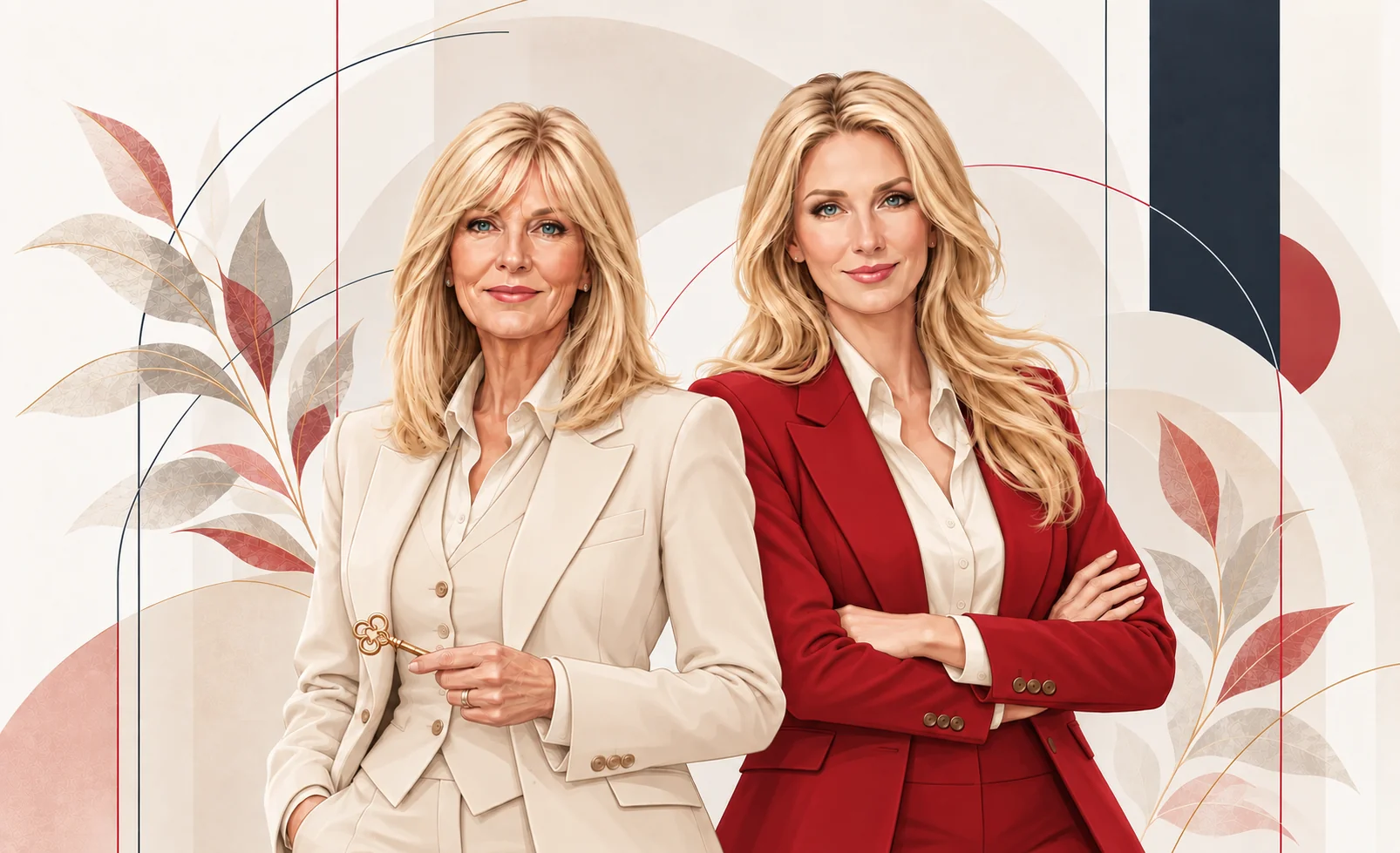
Illustration of Jill Kelleher and Amber Kelleher-Andrews. Image created by LM Editors.
HIGHLIGHTS:
- Founded in 1986 – Jill Kelleher established Kelleher International in the San Francisco Bay Area after seeing a need for a more personal approach to introductions.
- From video dating to dating apps – Their careers span a remarkable period of change in how people meet, from photographs and videotapes to websites, smartphones and today's dating platforms.
- A mother-daughter business – Jill's daughter, Amber Kelleher-Andrews, eventually became a central figure in the company and helped bring its matchmaking story into a new generation.
There is something a little unusual about the Kelleher story.
A mother started a matchmaking business in California in the 1980s. Years later, her daughter joins the family company and eventually becomes one of its most visible public figures. In between, the world of dating changes almost beyond recognition — from video dating and personal introductions to online profiles, smartphones and dating apps.
That makes this more than the story of a matchmaking company. It is also the story of two women working in the same unusual industry across two generations, while the rules of dating kept changing around them. And if you step back for a moment, there is an interesting question underneath it all: when people have more ways than ever to meet each other, why does finding the right person still remain difficult?
Who Are Jill Kelleher and Amber Kelleher-Andrews?
Let's start with Jill.
Jill Kelleher founded Kelleher International in 1986 after working for a video dating service in the early 1980s. The company's own account of its beginnings is particularly interesting because it explains what bothered her about the emerging video-dating model. Clients could look through photographs and videos and decide whom they wanted to meet, which meant that appearance could heavily influence who received attention. Jill saw another possibility — that the person doing the choosing did not necessarily have to be the client. Instead, a matchmaker could get to know the individual, understand what they were actually looking for and make an introduction based on something more substantial than a photograph.
That idea became the foundation of her business. And when you think about it, there is something surprisingly familiar about the problem she was trying to solve. Technology has changed enormously since the 1980s, but the basic difficulty hasn't: people can have plenty of options and still struggle to know which option is worth their time.
Then came Amber.
Amber Kelleher-Andrews, Jill's daughter, eventually entered the family business and became a major figure in its growth and public profile. She was not simply another employee carrying on a family tradition. Her background included modelling and acting, and she later became a highly visible matchmaking personality, including an appearance as a matchmaker on NBC's Ready for Love in 2013. Kelleher International later described her as a co-founder and co-CEO, reflecting the central role she came to play in the company.
So the story has two very different chapters. Jill built the original matchmaking philosophy; Amber helped carry that philosophy into a very different media and dating landscape.
Jill Kelleher — At a Glance
Note: Kelleher International traces its founding to 1986, while some BBB business records list 1984 as the business-start date. The company itself consistently identifies 1986 as the founding year.
Amber Kelleher-Andrews — At a Glance
Kelleher International announced Amber's death in April 2025, describing her as a co-founder, co-CEO, matchmaking visionary, wife and mother.
The Beginnings of Kelleher International
Think about dating in 1986.
There was no Tinder. No Bumble. No Hinge. No Instagram. There wasn't even mainstream online dating in the sense we understand it today. If you wanted to meet someone new, your options were still overwhelmingly based on friends, work, social circles, introductions, personal ads and the occasional unexpected encounter. Video dating was beginning to offer something new, but even that was a very different experience from scrolling through thousands of profiles on a phone.
Jill Kelleher was working in that emerging video-dating world when she noticed a problem. Clients could look at photographs and videos and choose who interested them, but that process could easily become superficial. According to Kelleher International's own account, Jill believed there was a better way: instead of allowing clients to make the initial selection entirely themselves, why not have a professional who actually knew the client decide which introductions might make sense? She subsequently founded Kelleher International in the San Francisco Bay Area in 1986.
That basic idea is worth remembering because it explains much of the company's identity decades later.
The technology changed. The dating environment changed. The number of available singles increased dramatically. But the underlying proposition remained relatively simple: Get to know the person first. Then think about who they should meet. That was the beginning of Kelleher International.
The early model in simple terms
- Get to know the client
- Understand what they are actually looking for
- Look beyond superficial first impressions
- Identify potential compatibility
- Make a personal introduction
It sounds straightforward now. In the 1980s, it represented a different way of thinking about the emerging dating industry.
Jill Kelleher Reviews: What Clients Say
This is where things become a little more complicated.
If you search for “Jill Kelleher reviews,” most of the publicly available customer feedback is not really about Jill personally. It is about Kelleher International, the business she founded. That distinction matters, especially when looking at a company that has existed for decades and has worked with clients across multiple locations and generations.
At the time of our review, the Better Business Bureau's headquarters profile listed 2 customer reviews, with an average of 3 out of 5 stars. One review was strongly positive: a client identified as Timothy L wrote in July 2026 that he had met his wife through Kelleher and was approaching their 20th wedding anniversary.
Kelleher International responded to the latter review, saying that the public account did not include the full history of the search and that the company had presented hand-selected candidates and refined the search based on feedback.
That gives us something useful — but it also shows why matchmaking reviews need a little context.
What the public reviews show
BBB itself cautions that information in its business profiles comes from third parties and is not independently verified by BBB; it also notes that complaint information should be considered in context. And that's the uncomfortable part of matchmaking.
A matchmaker can carefully select two people, talk to both of them, understand their preferences and believe there is a genuine reason for an introduction. Then the two people meet — and there is either chemistry or there isn't. Unlike buying a product, matchmaking involves another human being, and no professional can completely control what happens between two people once they sit across from each other.
So rather than asking whether the reviews prove that Kelleher International is universally good or bad, a more useful question is: What kinds of experiences have publicly documented clients described?
The answer is: different ones. That is worth acknowledging in any serious review of a matchmaking company.
Amber Kelleher-Andrews Joins the Family Business
Amber didn't begin her career as a traditional matchmaker. Before becoming a major figure in the family business, she worked as a model and actress, giving her a very different professional background from her mother. Eventually, however, she moved into matchmaking and became increasingly involved in Kelleher International's growth. By the 2010s, she was not simply working behind the scenes; she had become one of the public faces of the company.
Her appearance on NBC's Ready for Love in 2013 was an obvious turning point in terms of visibility. Suddenly, professional matchmaking was being presented to a much broader television audience, and Amber was part of that conversation. At the same time, Kelleher International was positioning itself in the high-end matchmaking market, including work with executives, entrepreneurs and affluent clients. A 2013 New York Times article, for example, profiled the company in the context of its high-end matchmaking business and its focus on Silicon Valley.
There is an interesting generational contrast here. Jill's early career was shaped by the first generation of video dating, while Amber's public career developed during the rise of reality television and online dating. In other words, the mother and daughter were working in the same fundamental business while communicating with two very different generations of daters.
Amber's career in numbers and dates
- 1995–1996 — Amber Kelleher-Andrews joined Kelleher International and began working in the family matchmaking business.
- 1997 — She opened Kelleher International's second office in Beverly Hills.
- Late 1990s — She moved into senior leadership and became CEO.
- 2000s — She helped expand Kelleher International across the United States and internationally.
- 2010s — She led the company's growth into a global matchmaking business, with offices and matchmakers serving clients internationally.
- 2013 — Kelleher International had 16 offices worldwide, while Amber continued as CEO.
- 2021 — She was identified as co-founder and CEO of Kelleher International.
- 2022 — John Berg joined the company as co-CEO alongside Amber.
- 2023–2025 — Amber continued as co-founder and co-CEO, remaining involved in the company's strategy and matchmaking operations.
That timeline tells the story surprisingly well: Amber's professional life covered a period in which matchmaking went from a niche, highly personal service to something people could discover through television, websites and eventually a huge digital dating ecosystem.
Building a Mother-Daughter Matchmaking Business
This might be the most interesting part of the whole story.
It would be easy to focus on the obvious things: the company's longevity, its luxury positioning, television appearances or the high-end clients associated with the business. But there is another story running underneath all of that — a mother and daughter building a professional business together over several decades.
Family businesses are not exactly famous for being simple. Add matchmaking to the equation and you have an unusual combination: personal relationships, emotionally important decisions, client confidentiality and a business that depends heavily on trust. Yet Jill and Amber managed to make their family relationship part of the company's identity rather than something completely separate from it.
Their public story also illustrates how different generations can approach the same profession differently. Jill entered matchmaking when personal introductions and video dating were still relatively new. Amber grew her career as dating moved into television, the internet and increasingly sophisticated digital platforms. Their experiences were different, but the central idea of personal matchmaking remained remarkably consistent.
In short: There is something quite human about that progression. Jill created a company around an idea she believed was missing from dating. Amber then inherited not only the company, but the philosophy behind it — and had to interpret that philosophy for a completely different era.
The Approach to Professional Matchmaking
The simplest way to understand Kelleher International's approach is to look at what it says it is not.
Today, the dating industry is heavily associated with algorithms, recommendation systems and enormous databases of profiles. Kelleher International's current AI disclosure says the company does not use algorithmic matching to select its introductions; it says match selection is human-led and that introductions are curated by its matchmaking team. The same statement also notes that the company may use AI tools for research and operational efficiency, while keeping matchmaking decisions and client interactions human-led.
That distinction is important.
It does not mean technology has disappeared from matchmaking. Quite the opposite. Modern matchmaking businesses operate in a world where research, communication, databases and digital tools are unavoidable. The difference is where the final decision sits.
Technology-led dating vs. human matchmaking
Simple, right? Well, not really.
A human matchmaker still has the same fundamental problem that every dating service has: two people have to want each other. The difference is that the matchmaker attempts to add another layer of judgment before the introduction happens.
That is essentially the philosophy Jill was exploring back in the 1980s — only the environment around it has changed dramatically.
From Local Matchmaking to an International Business
The scale of the business changed significantly over time.
Jill's original operation began in the San Francisco Bay Area. Decades later, Kelleher International describes itself as serving major metropolitan markets in the United States and selected international regions, including cities such as New York, Los Angeles, London, Toronto and Dubai.
The company's longevity is particularly notable when you consider how many completely different dating models have appeared during that time.
Four decades of dating
- 1980s — Video dating, personal introductions and traditional social networks.
- 1990s — Matchmaking becomes more established while the early internet begins changing how people communicate.
- 2000s — Online dating moves into the mainstream.
- 2010s — Smartphones and dating apps dramatically increase the number of potential connections.
- 2020s — Dating is increasingly digital, while high-end matchmaking continues to position itself around personal attention and curated introductions.
The Kelleher story therefore sits at an interesting intersection between old and new. The company was built before online dating existed as we know it, yet it has continued operating in a market now dominated by digital technology. That alone makes its history useful for understanding how professional matchmaking has adapted rather than simply disappeared.
Kelleher International Today
Today, Kelleher International remains a family-founded matchmaking business, although its leadership structure has evolved. Following Amber Kelleher-Andrews' death in April 2025, the company says it continues under founder Jill Kelleher alongside current leaders Jennifer Wills and John Berg.
The company's current positioning is still centered on professional, human-led matchmaking rather than algorithmic selection. Its own description emphasizes dedicated matchmaking teams, assessment, vetting and personal introductions.
There is also a useful historical perspective here. Kelleher International's own anniversary material says that 2026 marks 40 years since Jill Kelleher founded the firm. That means the company has now existed through several completely different generations of dating technology — and through a period in which the very idea of matchmaking changed from something that might sound old-fashioned to something increasingly associated with premium, personalized services.
What Makes Their Story Notable?
Their story is not really about technology winning or losing against traditional matchmaking. It is about something much simpler: the tools changed, but the human problem stayed the same.
In 1986, someone could look through a photograph or video and wonder whether another person might be right for them. In 2026, someone can swipe through hundreds of profiles in an evening and wonder exactly the same thing.
The difference is the number of choices. And maybe that is why the Kelleher story has lasted as long as it has.
Noncommercial sharing of this article is permitted, provided you include full attribution and a link back to Last Matchmaker.

