Talia Goldstein: From Hollywood Matchmaker to Three Day Rule
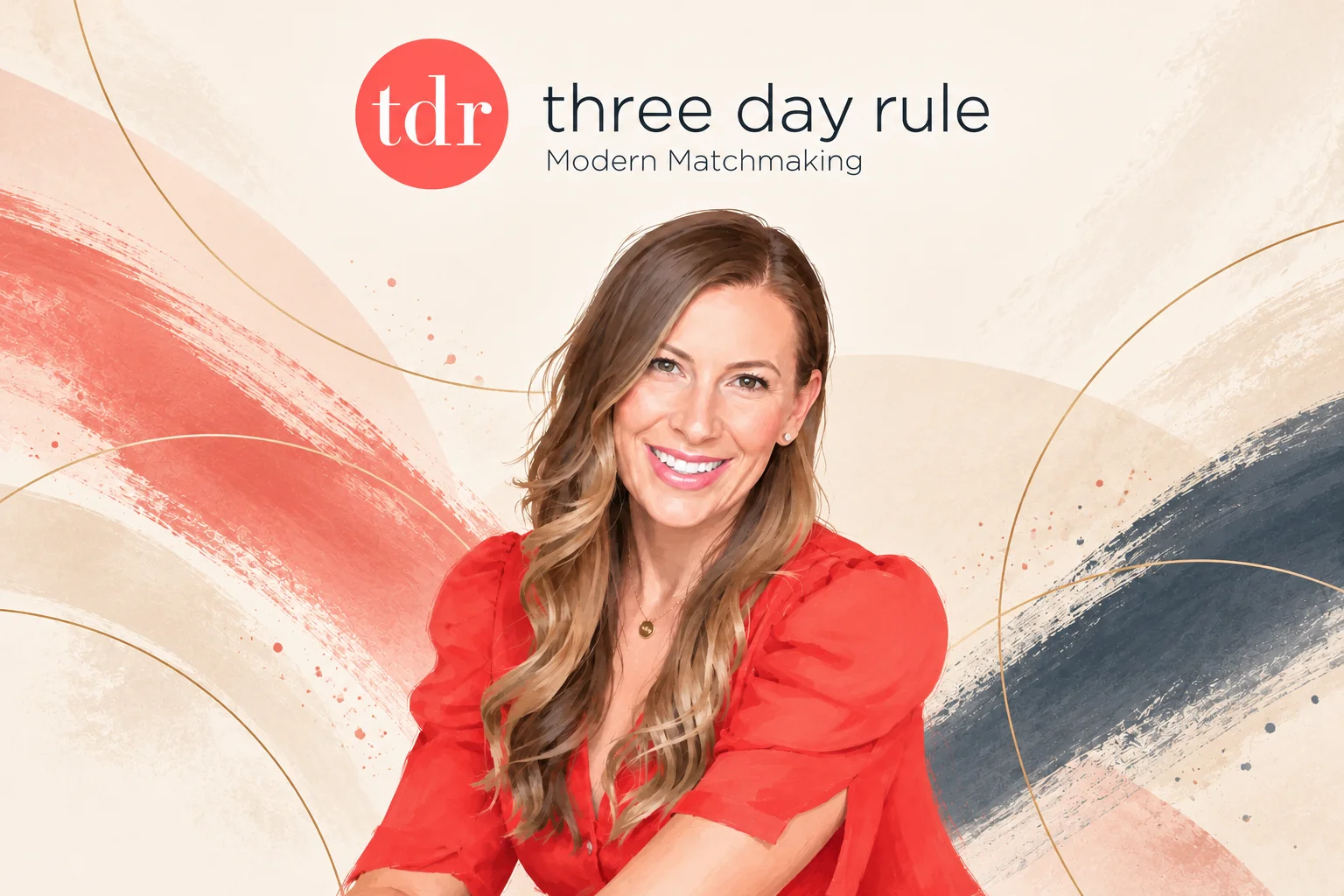
Illustration of Talia Goldstein. Image created by LM Editors.
HIGHLIGHTS:
- From television producer to matchmaker — Before founding Three Day Rule, Talia Goldstein worked in television in Los Angeles and became known among her coworkers as the person to see for dating advice and introductions.
- Three Day Rule was founded in 2013 — The company launched in Los Angeles as a technology-enabled personalized matchmaking business. Goldstein, however, describes the beginning of her matchmaking journey as early as 2010.
- Shark Tank changed the scale of the business — Three Day Rule appeared on Season 4 of Shark Tank. Goldstein later recalled that although the sharks passed, about 10,000 people signed up that night.
- Match/IAC investment followed — In 2014, Three Day Rule received investment from Match/IAC and developed partnerships with several major dating platforms.
There is something slightly unexpected about Talia Goldstein's career.
She did not begin in traditional matchmaking. She was working in television in Los Angeles, surrounded by friends and coworkers who were successful, interesting — and, quite often, single. Somewhere between her workday and conversations at the office, Goldstein became the person people came to for dating advice.
Then she started setting people up.
At first, it was simply something she seemed to be unusually good at. She could see connections between people that they did not necessarily see themselves. Eventually, the introductions became singles events, the events became a business, and the business became Three Day Rule.
That makes Goldstein's story interesting for another reason. She entered professional matchmaking at almost exactly the moment when dating was moving rapidly toward technology. Online dating was becoming mainstream, smartphones were changing how people communicated, and dating apps were beginning to make an enormous number of potential partners available with a few taps.
Goldstein did not respond by trying to pretend technology did not exist. Instead, Three Day Rule developed around a combination of technology and human matchmaking — a model in which databases and digital tools could expand the search, while matchmakers still played a role in understanding people and selecting introductions.
In that sense, Talia Goldstein's career sits somewhere between two eras of matchmaking: the highly personal world of introductions and mixers, and the data-rich dating environment that followed.
Who Is Talia Goldstein?
Let's start with the career that came before matchmaking.
Goldstein graduated from Tulane University in 2002 and moved into television production in Los Angeles. According to Tulane's profile of her, she worked as a producer for E! True Hollywood Story. It was there, rather unexpectedly, that her second career began to emerge.
Goldstein has described becoming the unofficial dating expert in her office. People would come to her cubicle to ask for relationship advice, and she began introducing coworkers and friends to one another. In one of the stories she has told about the early days, she made it her mission to match what she called the "grumpiest guy" in the office. When the introduction worked and she saw how happy he became, she realized that matchmaking might be more than something she simply enjoyed doing on the side.
There is an important detail in that story: Goldstein describes herself as becoming an entrepreneur almost by accident. She wasn't starting with a carefully constructed business plan for a matchmaking company. She first discovered that she had a particular talent for connecting people, then gradually built a business around it.
Talia Goldstein — At a Glance
The Matchmaker in the Television Office
The office where Goldstein worked at E! Entertainment might seem like an unlikely place to discover a matchmaking career.
But perhaps it was exactly the right environment.
She was surrounded by people working in entertainment, media and Hollywood — a social environment where relationships, appearance, personalities and professional networks were constantly intersecting. Goldstein began giving people advice and introducing them to one another, and the activity gradually became a noticeable part of her working life.
"I would sit in my cubicle, and people would come up all day and ask for relationship advice," Goldstein told Tulane.
That sentence probably explains the beginning of Three Day Rule better than a conventional business biography could. She wasn't initially trying to become a matchmaker. People were simply recognizing something in her.
There is also something important about the way she describes the discovery. The skill wasn't presented as an ability to identify two people who looked compatible on paper. It was about knowing people well enough to make a judgment about who might work together.
That distinction would eventually become central to Three Day Rule's identity.
Goldstein left television and began experimenting with matchmaking on a larger scale. The first step wasn't immediately a sophisticated matchmaking company. It was something much simpler: get singles into the same room. And then see what happens.
From Singles Parties to Three Day Rule
Goldstein began hosting events for singles, and the numbers grew quickly.
Tulane reported that her first party had around 20 people, with subsequent events growing to approximately 300 attendees within a few months. Goldstein later gave an even larger figure in a Nasdaq Center interview, recalling that some events eventually attracted around 600 paying singles.
The scale of those events created a revealing moment.
Goldstein found herself standing in a room filled with successful, attractive and interesting single people who had actually paid to attend a matchmaking-oriented event. Yet many of them were still struggling to find relationships.
That raised a question: if so many people were available, why was finding the right person still difficult? For Goldstein, the answer wasn't necessarily that people lacked opportunities to meet. They already had plenty of opportunities.
Maybe the problem was what happened between meeting someone and deciding whether they were worth pursuing. That idea pushed her beyond events and toward personalized matchmaking.
The Early Progression
The company name itself came from an older dating convention.
Goldstein has explained that "Three Day Rule" was inspired by the 1990s film Swingers, in which a character is advised to wait three days before calling a woman after getting her number. The joke, of course, was that dating rules were becoming increasingly artificial — and Goldstein's matchmaking company would eventually take a different approach.
The irony is quite good. The company was named after a dating rule that said people should wait. The business Goldstein built was designed to help people become more intentional about who they meet in the first place.
Three Day Rule Goes on Shark Tank
Then came television again — but this time, Goldstein wasn't producing the show. She was pitching her own company.
The interesting part is what happened after the rejection. In the traditional startup story, the memorable moment would be getting the investment.
For Three Day Rule, the more important outcome may have been the exposure. A television audience suddenly knew that personalized matchmaking existed, knew the name Three Day Rule, and could immediately investigate the service.
And then another significant development followed.
In 2014, Three Day Rule received investment from Match/IAC. The Nasdaq Center's profile of Goldstein says that the investment was followed by partnerships with Match, OkCupid, JDate, Christian Mingle and The League.
That was an important development because it showed that the company wasn't positioning human matchmaking and online dating as mutually exclusive worlds.
Instead, Three Day Rule could use the enormous candidate pools associated with digital dating while retaining matchmakers as part of the process.
There is a useful lesson in the sequence.
The company didn't need the television investors to say yes for Shark Tank to become valuable. Exposure itself became an asset.
And the subsequent Match/IAC investment connected Three Day Rule to a much larger dating ecosystem.
For a company built around personal matchmaking, that combination was unusual: a small, relationship-focused human service gaining access to the infrastructure of one of the biggest names in online dating.
Talia Goldstein and the Human Side of Matchmaking
This may be the most interesting part of Goldstein's business model.
Three Day Rule was created during the period when dating technology was becoming increasingly sophisticated. Yet the company did not argue that people could simply be reduced to data points.
Instead, its positioning developed around a combination of technology and human judgment.
Three Day Rule currently describes itself as a technology-enabled personalized matchmaking company and says its matchmakers combine technology with intuition to vet potential matches.
That philosophy is visible in Goldstein's earlier descriptions of the business as well. A 2018 Nasdaq interview described Three Day Rule as using a "human-touch approach" and noted that candidates were expected to meet members of the team before introductions.
At the same time, the company has never been purely offline.
Goldstein has also described the search as extending beyond a database.
In an NPR interview, she explained that if a client was interested in someone from a particular professional world, matchmakers could look for candidates at places such as real-estate or medical conferences.
That detail is important because it changes the meaning of "matchmaking." The matchmaker isn't necessarily waiting for the perfect candidate to appear on a screen. The search can theoretically move into the real world.
A candidate might be found through an existing database, another dating platform, a personal network, a professional event or a recommendation. The technology expands the field; the matchmaker helps determine which people deserve further attention.
Of course, that doesn't remove the uncertainty inherent in matchmaking. A matchmaker can identify two people who appear compatible, but neither the database nor the matchmaker can manufacture chemistry.
The introduction still has to become a real conversation between two independent people. And that is probably the most important limitation to keep in mind when looking at any professional matchmaking model.
Talia Goldstein Reviews: What Clients Say
This is where the public record becomes more complicated — and therefore more interesting.
If you search for reviews of Talia Goldstein, most public reviews are actually reviews of Three Day Rule, not evaluations of Goldstein personally. Goldstein is the founder and current president, but individual clients generally work with one of the company's matchmakers.
At the time of our review in October 2026, Three Day Rule's Trustpilot profile displayed 89 reviews and a 4.4/5 TrustScore. Trustpilot showed 76% of reviews at five stars and 16% at one star, with the remainder distributed among the other ratings.
That distribution matters. The overall rating is positive, but it isn't a record of uniformly positive experiences.
What the Public Reviews Show
There are some particularly recent examples.
One July 2026 reviewer said they spoke with Talia Goldstein before purchasing a three-month subscription and subsequently said their matchmaker helped them find a fiancé. That is the customer's account of the experience, rather than an independently verified outcome.
Other recent reviewers have praised individual matchmakers for listening carefully, providing feedback after dates and helping them navigate the process.
But the negative reviews should not be ignored.
Some 2026 reviewers described dissatisfaction with the relevance of introductions, communication or the candidate pool. One reviewer specifically argued that the service did not provide the level of personalization they expected after paying thousands of dollars. Three Day Rule responded publicly to that review, saying that matchmaking is a highly personal process and that it takes concerns about the experience seriously.
That gives us something useful, but also something that needs context. A matchmaking review is not quite like a hotel review. If someone books a hotel room and the room is dirty, the problem can usually be identified objectively. In matchmaking, two people can meet, have an entirely pleasant evening and still decide that there is no romantic connection.
One recent reviewer on Trustpilot made exactly that distinction in a positive review: the introduction wasn't ultimately a romantic match, but the reviewer still praised the matchmaker's understanding and follow-up.
That is an important reminder. A matchmaker can control the quality of the search and the introduction process. They cannot control whether two strangers fall in love.
Talia Goldstein's Business Philosophy
Goldstein's story becomes even more interesting when the subject moves away from dating and into entrepreneurship.
In a 2018 interview with the Nasdaq Center, she described entrepreneurship as having a mission you believe in strongly enough to pursue despite uncertainty. She emphasized passion, persistence, hiring the right people and being willing to take risks.
But her most revealing story concerns what happened when she listened to other people's advice.
Goldstein has said that investors and advisors told her the dating industry was already too saturated and that Three Day Rule would struggle to succeed. Because those people were successful business people whose opinions she respected, she temporarily shut down the dating company and started another business that seemed more aligned with the market at the time.
Six months later, she realized something.
The new business might have been doing reasonably well, but she wasn't passionate about it. So she closed it and relaunched Three Day Rule.
Her lesson was simple: opinions are data points, but you still have to trust your own judgment.
There is an interesting connection between that philosophy and matchmaking itself. Matchmaking is full of opinions.
A client has an opinion about the person they think they want. A friend has an opinion about who they should date. A matchmaker has an opinion about compatibility. Two people then meet and form an opinion about each other.
None of those opinions is guaranteed to be correct.
That may explain why Goldstein has emphasized the importance of getting to know the person rather than relying exclusively on a checklist.
In short: It is a distinctly founder-oriented philosophy: the business exists not simply to sell introductions, but to solve a problem Goldstein believes matters. And perhaps that explains why she stayed with matchmaking even after being told that the market was already too crowded.
Three Day Rule Today
Three Day Rule is now very different from the small matchmaking operation that began with Goldstein's friends, coworkers and singles events.
The company's current website describes it as a personalized, technology-enabled matchmaking company serving singles looking for meaningful relationships. It says its matchmakers use technology alongside intuition to vet potential matches.
Goldstein remains publicly associated with the company. Three Day Rule's current matchmaker page identifies her as Founder & President, while Goldstein's own 2026 account says that Adam Cohen-Aslatei is now the company's CEO.
From Hollywood to Modern Matchmaking
Three Day Rule emerged from contradiction: more technology, more profiles and more opportunities did not necessarily make choosing the right person easier.
Goldstein's answer was not to abandon technology. It was to put a person back into the process. That is ultimately what makes her career worth looking at in the broader history of professional matchmaking.
Jill Kelleher entered the industry before mainstream online dating existed and built a business around the idea that a professional could make a better introduction than a photograph alone.
Talia Goldstein entered matchmaking from the opposite direction. She came from a digital-media environment and built a company while online dating was rapidly becoming the dominant way people met.

