The Neuroscience of Emotional Connection Today

Highlights
- 3 forces shape emotional connection: biology, psychology, and shared experience.
- Feeling understood matters. Perceived partner responsiveness is closely associated with intimacy and relationship quality.
- 2 forms of intimacy can overlap without being identical: physical connection and emotional connection.
- Sex can deepen emotional connection. When intimacy is accompanied by trust, vulnerability, affection, and responsiveness, sexual experiences can become part of how partners build and reinforce emotional closeness.
Why do we sometimes meet someone and feel an immediate sense of connection, while other interactions leave us feeling almost nothing?
Why can one person's attention become especially meaningful? Why can a conversation with one person stay in our minds for days, while another perfectly pleasant conversation disappears almost immediately?
And perhaps most importantly: why can feeling genuinely understood by another person create a sense of closeness that seems to go far beyond physical attraction?
The science of relationships suggests that emotional connection is much more complicated than simply having “chemistry.”
Romantic love and attachment involve biological systems associated with reward, motivation, emotion, and social bonding. But what we experience as closeness is also shaped by what happens between two people: what they reveal to one another, how they respond, whether they listen, and whether each person feels understood, valued, and cared for.
Emotional connection, therefore, is not simply something that happens inside the brain.
It develops between people.
What Is Emotional Connection?
Emotional connection is the sense of closeness that develops when two people feel psychologically seen, understood, valued, and emotionally safe with one another.
It can exist in romantic relationships, friendships, families, and other meaningful relationships. In romantic dating, however, it often becomes especially important because attraction alone does not necessarily create intimacy.
You can be physically attracted to someone without feeling emotionally close to them. You can enjoy someone's company without feeling that you can truly open up. And you can meet someone who is not immediately your “type” but gradually become deeply attached as trust, familiarity, and understanding develop.
That distinction matters.
Emotional connection is not simply the intensity of a feeling. It is also the quality of the interaction that creates the feeling.
A useful way to understand it is through four overlapping experiences:
These experiences do not necessarily appear all at once.
Emotional closeness can develop gradually through hundreds of small interactions: remembering something important, asking a thoughtful question, responding with empathy, showing up when promised, sharing something vulnerable, laughing together, or simply paying attention.
This is why emotional connection can sometimes feel difficult to explain. There may be no single dramatic moment when it begins. Instead, the brain and the relationship gradually accumulate evidence:
- This person notices me.
- This person understands me.
- This person responds to me.
- I can trust this person.
Over time, those experiences can become the foundation of intimacy.
Based on research published in the Journal of Social and Personal Relationships. View study on PubMed →
Emotional connection is not the opposite of attraction. For many couples, attraction and emotional closeness develop together. For others, one may appear before the other. The important point is that neither physical chemistry nor emotional intimacy alone tells the whole story of romantic compatibility.
The Neuroscience of Emotional Connection
It's More Than Chemistry
It is tempting to explain attraction through a single chemical or brain region.
Popular culture often calls dopamine the “pleasure chemical” and oxytocin the “love hormone.” These descriptions are memorable, but they can make the science sound much simpler than it really is.
Love does not have a single chemical switch.
Research into the neurobiology of love points instead to several interacting systems involving reward, motivation, emotion, cognition, and social bonding. A 2022 meta-analysis of human neuroimaging studies found evidence linking passionate love with activity in reward-related brain regions, while also discussing the coordinated roles of dopaminergic, oxytocinergic, and vasopressinergic pathways in love and attachment.
3 Forces That Shape Emotional Connection
The brain matters, but it does not work in isolation. Emotional connection emerges from the interaction between biological processes, individual psychology, and what two people repeatedly experience together.
That distinction is important. Dopamine does not “make you fall in love.” Oxytocin does not automatically make someone trustworthy. And there is no single brain region responsible for emotional intimacy.
Instead, these systems participate in broader processes involving motivation, reward, social behavior, attachment, and learning.
In short: The brain may help explain why someone becomes important to us, but it cannot fully explain why this particular person becomes important to us. That second question brings the relationship itself into the picture.
From Attraction to Attachment
Attraction can bring two people together.
Attachment can help explain why the relationship becomes emotionally meaningful over time.
When someone is new, novelty itself can be powerful. We pay attention. We become curious. We want to know more. Positive interactions may encourage us to seek another interaction, and another.
Over time, repeated experiences can create familiarity. Familiarity can create predictability. Predictability can create trust. And trust can make vulnerability easier. One simplified way to think about this progression is:
It is not a rigid biological sequence, and relationships do not all follow the same path. But it illustrates an important idea: emotional bonds are often strengthened by repeated experiences rather than a single moment of chemistry.
Oxytocin and vasopressin are frequently discussed in research on social bonding and pair bonding, but neither should be reduced to a simple “love hormone” explanation. Their effects depend on context, individual differences, and the social environment.
The broader lesson is more interesting than the popular version: attachment is not simply something that happens to us. It develops through repeated experiences of connection, support, familiarity, and responsiveness.
Why Feeling Understood Matters
Perhaps one of the most important pieces of the puzzle is also one of the simplest:
We want to feel understood.
Relationship researchers use the term perceived partner responsiveness to describe the experience of believing that another person understands you, validates important aspects of who you are, and cares about your well-being.
This idea is central to research on intimacy.
Reis and Shaver's interpersonal process model proposed that intimacy develops partly through self-disclosure and responsive interaction. Later research has continued to find that perceived responsiveness is closely associated with intimacy and relationship quality.
Think about the difference between:
“They listened to me.”
and:
“They really understood me.”
The second experience can feel much more personal. When someone shares something vulnerable, the response matters. A dismissive response may cause the person to retreat. A distracted response may communicate that the disclosure was not important. But a response that communicates genuine attention, understanding, and care can encourage further openness.
This can create a cycle:
That may be one reason a conversation with someone can feel unexpectedly meaningful, even when you have not known them very long. Sometimes what makes an interaction memorable is not simply what was said. It is the feeling that the other person really got you.
Building Closeness in a Relationship
Emotional connection in a relationship is rarely built through one grand romantic gesture. More often, it is built through ordinary moments.
- A partner asks about something you mentioned days earlier.
- They notice when you are quieter than usual.
- They remember what makes you nervous.
- They listen when you need to talk instead of immediately trying to solve the problem.
- They share something vulnerable in return.
These behaviors can communicate something powerful:
You matter to me, and I am paying attention.
Research on perceived partner responsiveness suggests that feeling understood, valued, and supported is strongly associated with closeness and relationship quality. Studies have also found that responsiveness can develop through reciprocal cycles between partners.
Signs of a Strong Emotional Bond
There is no universal checklist for emotional intimacy, but several experiences commonly accompany a strong emotional bond.
You may notice that:
- You can talk about more than practical matters.
- You feel comfortable sharing your genuine thoughts and feelings.
- You do not constantly have to perform or impress each other.
- Your partner remembers details that matter to you.
- You feel listened to rather than simply heard.
- Difficult conversations do not automatically threaten the relationship.
- You can ask for support without feeling ashamed.
- You enjoy silence together as well as conversation.
- You are interested in each other's inner worlds.
- Affection feels meaningful rather than purely physical.
- You feel that your partner knows the person behind your public image.
None of these guarantees a healthy relationship on its own.
But together, they point toward something important: psychological closeness.
Types of Emotional Bonds
Not every meaningful bond looks the same. Romantic relationships may involve several overlapping forms of closeness:
A couple does not need to match perfectly in every category. In fact, compatibility does not mean being identical. The question is whether the differences can coexist with enough understanding, respect, attraction, trust, and shared direction to create a satisfying relationship.
Physical Connection vs. Emotional Connection
Physical connection and emotional connection can overlap, but they are not interchangeable.
Physical attraction may be immediate.
Emotional intimacy often takes longer.
You might feel an intense physical attraction toward someone you barely know. At the same time, you might feel deeply emotionally connected to someone without experiencing the same immediate physical intensity.
Neither experience is inherently more “real.”
They simply involve different dimensions of human attraction and intimacy.
Physical connection may involve:
- sexual attraction
- physical chemistry
- touch
- kissing
- desire
- excitement
- sensory attraction
Emotional connection may involve:
- trust
- vulnerability
- empathy
- feeling understood
- emotional safety
- mutual care
- shared meaning
The two can reinforce each other.
A partner who makes you feel emotionally safe may become more physically attractive over time. Physical affection can also communicate care and reinforce feelings of closeness.
Research on affectionate touch, for example, suggests that it is associated with greater perceived partner responsiveness in romantic relationships.
But physical chemistry cannot substitute for emotional compatibility indefinitely. A relationship can have strong sexual attraction and still feel emotionally empty. Conversely, emotional closeness can exist without strong sexual desire.
In short: Understanding the distinction can be particularly useful in dating because people sometimes interpret one type of attraction as evidence that all forms of compatibility are present. They are not necessarily the same thing.
Emotional Connection During Sex
Sex can be intensely physical, deeply emotional, or both. For some couples, sexual intimacy becomes one of the strongest ways they communicate affection and closeness. For others, sex may be enjoyable without necessarily creating a deeper emotional bond.
The difference often comes down to context. Sex does not automatically create emotional intimacy. But when trust, vulnerability, responsiveness, affection, and desire are already present, sexual intimacy can become an extension of the emotional relationship.
There is also evidence that responsiveness matters in the sexual domain. Research involving couples has linked perceived responsiveness to sexual and relationship quality, suggesting that feeling that a partner is attentive and responsive to one's needs can matter inside as well as outside the bedroom.
This helps explain why the same physical experience can feel completely different with different people. The physical act may be similar. The emotional meaning is not.
For one person, sex may communicate:
“I want you.”
For another, it may communicate:
“I trust you.”
For another:
“I feel close to you.”
And sometimes it communicates all three.
Physical intimacy can create emotional closeness, but it does not guarantee it. The surrounding relationship matters.
In short: How partners communicate before and after sex, whether they feel safe expressing preferences, whether their needs are respected, and whether affection exists outside the bedroom can all shape the emotional meaning of sexual intimacy.
When Intimacy Starts to Fade
Relationships change. The intensity of early dating does not remain constant forever, and that does not necessarily mean something is wrong. The problem is not that a relationship becomes less exciting than it was during the first few months.
The more important question is whether closeness, curiosity, responsiveness, and affection continue to exist underneath the changing intensity.
Sometimes couples remain deeply connected even when the relationship feels calmer. Other times, something more significant has changed.
Understanding Emotional Disconnection
Emotional disconnection can be understood as a growing sense of distance between two people who were previously close.
It may look like:
- conversations becoming mostly practical
- less curiosity about each other's inner lives
- avoiding vulnerable subjects
- feeling unheard or misunderstood
- reduced affection
- spending time together without feeling together
- repeatedly turning toward other people for emotional support
- feeling lonely while in the relationship
- becoming reluctant to share problems because “what's the point?”
- losing the sense that your partner really knows you
Emotional disconnection does not always happen because love has disappeared. Sometimes it develops through accumulated disappointments.
A partner repeatedly fails to listen.
A difficult subject is avoided again and again.
Small resentments are never discussed.
Stress takes over.
Sex becomes disconnected from affection.
Life becomes so busy that the relationship receives only leftover attention.
Eventually, two people who still care about one another may discover that they no longer feel particularly close.
How to Build or Rebuild an Emotional Connection
If emotional closeness develops through repeated experiences, rebuilding it usually requires repeated experiences too. There is rarely one conversation that fixes everything. Instead, small changes can gradually create a different pattern between two people.
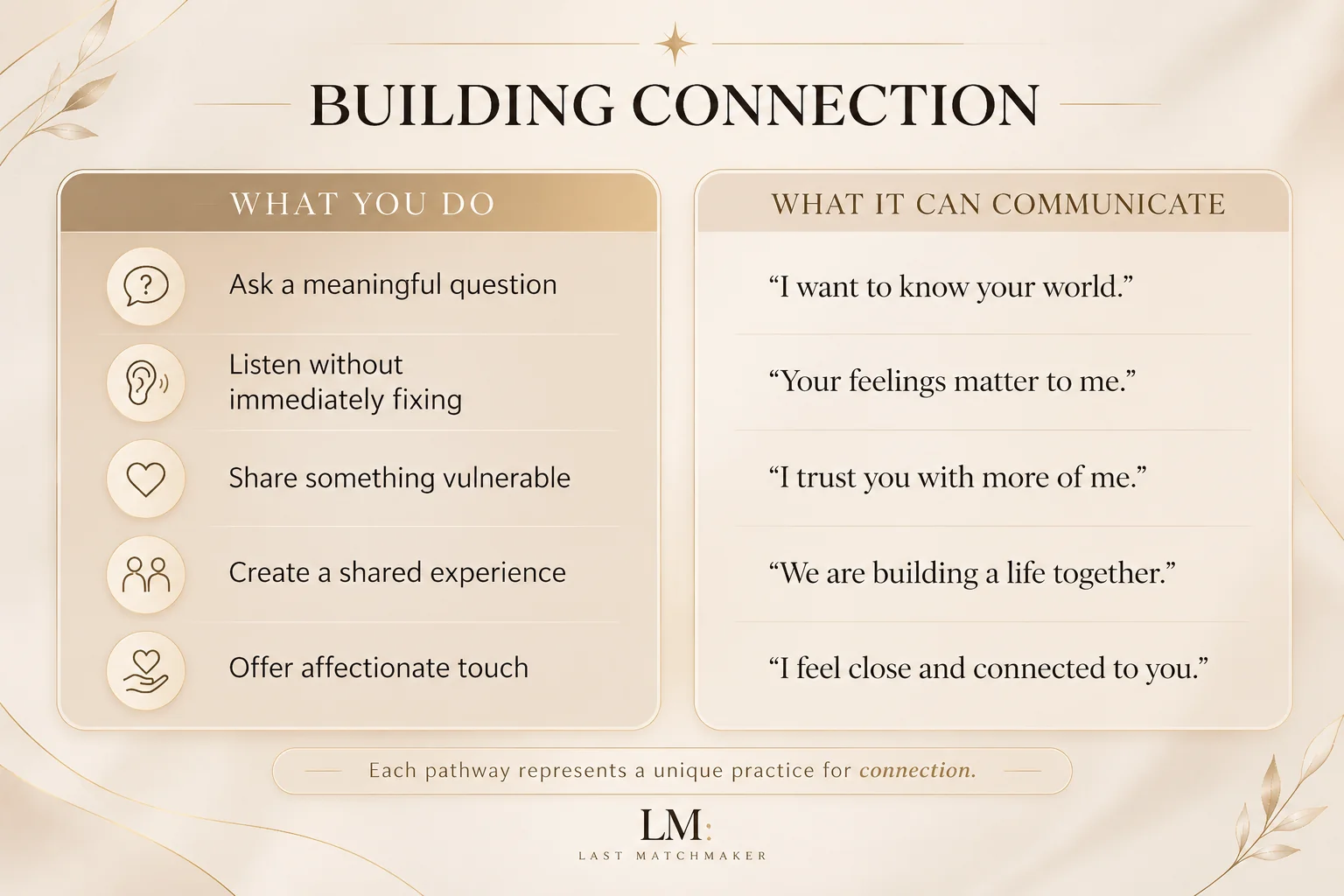
There are six practical ways to create more emotional closeness: better questions, deeper listening, vulnerability, shared experiences, physical affection, and addressing unhealthy relationship patterns.
1. Ask Better Questions
Move beyond routine questions such as “How was your day?” and create more room for personal disclosure. Asking what has been on someone's mind, what they are looking forward to, or whether something has been difficult lately can communicate genuine interest in their inner world.
2. Listen for Understanding
Listening is not simply waiting for your turn to speak. Before offering advice or solutions, try to understand what the other person is actually experiencing. A simple response such as “I can understand why that affected you” can sometimes create more closeness than immediately trying to fix the problem.
Research on perceived partner responsiveness emphasizes the importance of feeling understood, validated, and cared for in close relationships.
3. Share Something Real
Emotional intimacy requires some degree of reciprocity. Gradually sharing your concerns, experiences, hopes, or vulnerabilities gives your partner the opportunity to know you more deeply. Healthy vulnerability does not mean revealing everything at once; it develops alongside trust.
4. Create Shared Experiences
Connection is built through more than conversation. Shared activities, regular walks, cooking together, weekend trips, new experiences, or small relationship rituals create memories and a sense of shared history.
Some simple ways to create more opportunities for connection include:
- Put away phones during part of the evening.
- Try something neither partner has done before.
- Create a regular ritual that belongs to the two of you.
- Make time for conversations that are not about work, schedules, or problems.
5. Restore Physical Affection
Physical affection does not have to mean sex. A hug, holding hands, sitting close, or a kiss before leaving for work can communicate warmth and reassurance. Research suggests that affectionate touch can contribute to feelings of closeness and relationship security.
6. Address the Pattern, Not Just the Argument
Some couples become caught in repetitive cycles: one person pursues while the other withdraws, one asks for reassurance while the other feels pressured, or one becomes critical while the other becomes defensive.
Instead of asking only “Who is right?”, it can be more useful to ask, “What keeps happening between us?” Recognizing the pattern can help couples identify the underlying need rather than repeatedly fighting about the same surface-level disagreement.
Rebuilding emotional connection is rarely about finding one perfect solution. It is about creating enough new experiences of attention, responsiveness, vulnerability, affection, and trust that the relationship begins to feel different again.
When Couples Therapy May Help
Sometimes a couple can identify the problem but cannot change the pattern alone. This is one situation in which couples therapy may be useful.
Roddy, M. K., Walsh, L. M., Rothman, K., Hatch, S. G., & Doss, B. D. (2020). Meta-analysis of couple therapy: Effects across outcomes, designs, timeframes, and other moderators. Journal of Consulting and Clinical Psychology, 88(7), 583–596. PubMed — full research record
Research specifically examining emotionally focused couples therapy has also found improvements in marital satisfaction, although the strength and durability of effects vary across studies and approaches.
Therapy is not a guarantee that a relationship will survive. Nor should it be treated as a last-minute repair service. For some couples, professional support can simply provide a structured environment in which both people can understand their patterns, communicate more effectively, and decide what they want from the relationship.
What This Science Means for Dating Today
Understanding the science of emotional connection does not provide a formula for making someone fall in love and that's probably a good thing.
There is no perfect sentence, texting strategy, or psychological trick that can manufacture genuine intimacy. The brain may help explain some of the biological processes involved in attraction, love, and attachment, but emotional connection is more complex than biology alone.
What happens between two people matters, too: how they communicate, how they respond to one another, whether they feel safe opening up, and whether they feel seen and understood.
Love may begin with chemistry, but meaningful connection is built through the moments that make us feel truly seen, understood, and known.

